Do You Really Need an AI Coding Tool for Your Development Team?
GitHub Copilot, Cursor, Tabnine, Amazon CodeWhisperer - the AI coding assistant market is growing fast, and the marketing around these tools is aggressive. Productivity gains of 55 percent. Developers shipping twice as fast. Junior developers performing at senior levels. The numbers are real, but they are averages across a wide range of use cases, and the gap between average results and your results depends heavily on what your team is building and how your workflow is structured.
Honest answer: for most development teams, some form of AI coding assistance will improve productivity on the right tasks. The question is not really whether to use it - it is which tool, for which tasks, with what governance in place.
What AI Coding Tools Actually Do Well
The productivity gains from AI coding assistants are real and well-documented. The tasks where they deliver the clearest value are:
Boilerplate generation. Setting up a new API endpoint, writing a test file structure, scaffolding a database model - tasks where the pattern is well-understood and the work is primarily repetitive. AI tools handle these quickly and correctly. Developers who spend significant time on scaffolding see the clearest benefits.
Completion within established patterns. When a developer is in the middle of writing a function and the next few lines follow a predictable pattern - continuing a for loop, completing a try-catch block, finishing a method that follows a clearly established structure - AI completion is fast and accurate. This is the use case the tools were originally designed for.
Generating test cases for existing code. Writing tests for a function that already exists is well-suited to AI assistance. The function's inputs and outputs are defined; the AI generates test cases across the input range. The generated tests still need review, but they provide a starting point that is faster than writing from scratch.
Translating between formats. Converting JSON to TypeScript types, transforming a SQL schema to an ORM model, converting a Python dict structure to a Pydantic model - these translation tasks are mechanical and time-consuming. AI tools handle them accurately and quickly.
For development teams doing significant amounts of this kind of work, AI coding assistance is worth the cost of the subscription.
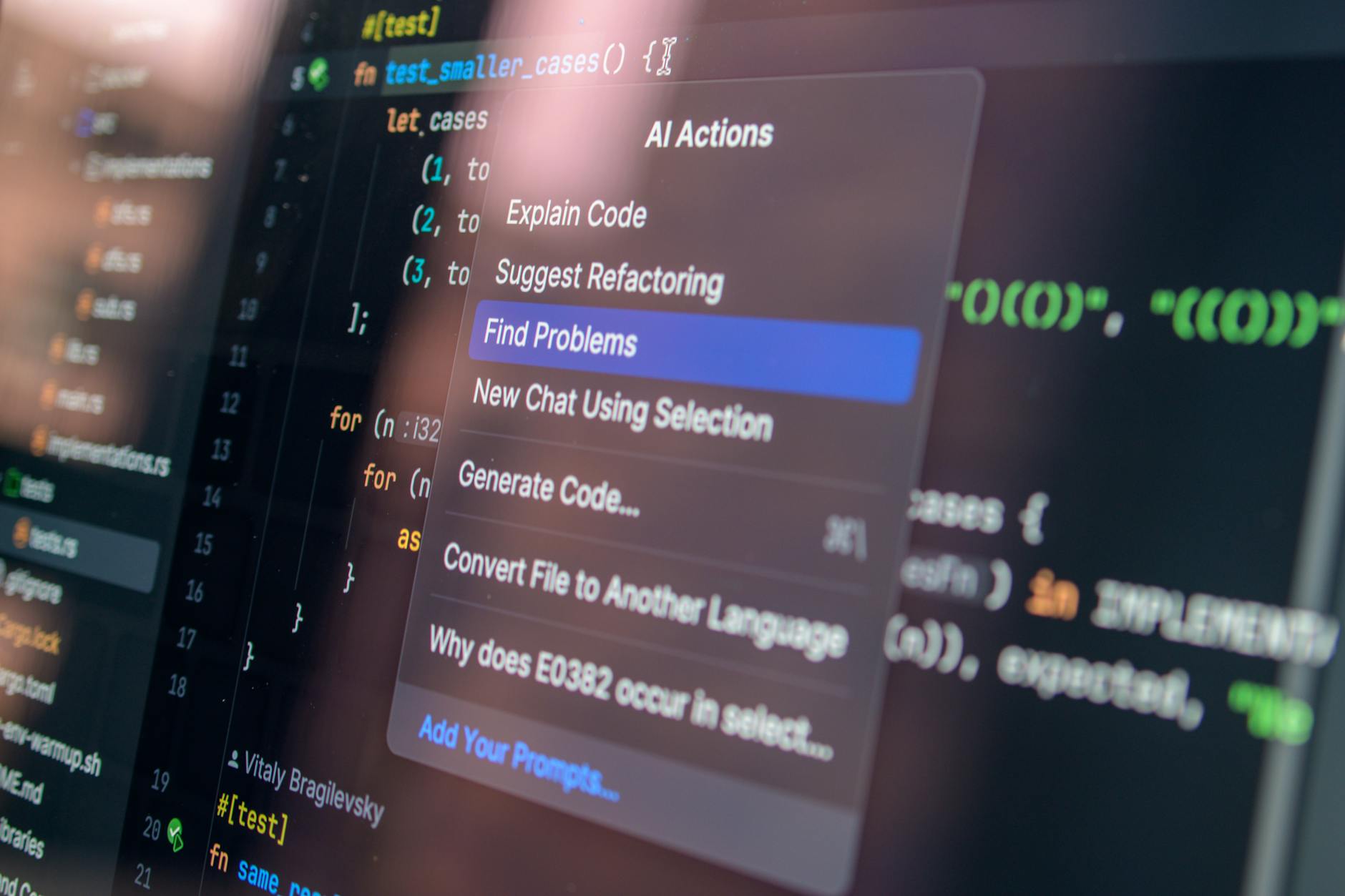 Photo by Daniil Komov on Pexels
What AI Coding Tools Do Poorly
The same tools that accelerate boilerplate generation struggle with tasks that require understanding context that is not in the visible code.
Architectural decisions. How to structure a new feature, how to design an API that multiple teams will use, how to handle state management across a complex system - these decisions require understanding the full context of the application. AI tools see only what is in the prompt. They produce suggestions that look plausible but may be incompatible with decisions made elsewhere in the codebase.
Security-sensitive implementations. Authentication flows, authorization logic, encryption, and secure data handling all require understanding the specific threat model for the application. AI tools produce implementations that follow common patterns, which may not match the specific security requirements for your context. Organizations in regulated industries have found AI-generated security code requires significant review before it can be trusted.
Performance-critical code. AI tools optimize for correctness, not performance. Code that looks correct but performs poorly under production load is a consistent problem. Database queries that work on test data and time out on production data, algorithms that are functionally correct but have the wrong complexity class for the input sizes they will encounter - these failures appear after deployment, not in tests.
Code that requires understanding recent changes. The AI does not know about the refactor that changed your data model last week, the API upgrade that changed the return type of a method, or the deprecation decision made in last sprint's planning session. It generates code based on what it can see and what it knows from training. That knowledge is often several months out of date relative to your current codebase.
What You Actually Need for Most Use Cases
For a development team of two to ten people doing typical web application, API, or service development, the practical answer is:
A mid-tier AI coding subscription ($10-20/month per developer) covering code completion and generation. Use it for boilerplate, test generation, and format translation. Do not use it for architectural decisions or security-sensitive implementations.
A static analysis setup that runs in CI - an ESLint or Pylint configuration, a security scanner like Semgrep, and a test coverage threshold. This catches the categories of issues AI tools produce most consistently, without requiring every reviewer to manually check for them.
A simple code review protocol that makes AI-generated code visible (a checkbox in the PR template) and that specifically asks reviewers to check error handling and architectural fit.
This setup costs about $20-40/developer/month in tooling, takes a few days to configure, and captures most of the productivity benefit while managing the most common quality risks.
"The teams that get the most value from AI coding tools are not the ones that use them the most. They are the ones that use them for the tasks the tools handle well and have a process for reviewing what comes out." - Dennis Traina, 137Foundry
When Custom Development or Consulting Makes Sense
If your team is building something where the AI's failure modes create meaningful risk - regulated industries, high-security applications, systems with complex architectural requirements - the calculus changes.
The productivity gains from AI tools are offset by the review overhead required when the stakes for a bad suggestion are high. A security vulnerability in a financial application or a data handling error in a healthcare system has consequences that exceed the cost of slower development.
In these contexts, working with a development partner who has already worked through the tooling, governance, and review processes for AI-assisted development is worth considering. Custom software agency 137Foundry helps companies build production-grade applications where code quality governance is built into the workflow - not added retroactively after problems surface.
For teams that have adopted AI coding tools but have not yet formalized the governance around them, the guide on integrating AI coding tools without technical debt is a practical starting point for understanding what policies to put in place and what to measure.
 Photo by cottonbro studio on Pexels
The Clearest Recommendation Based on Team Size
Individual developers and small teams (1-3 people): AI coding assistance is worth it for most projects. The governance overhead is low because one or two people own the full codebase. The quality risks are real but manageable with basic tooling.
Medium teams (4-15 people): AI coding assistance is worth it, but needs formal governance. Implement the PR template changes, the CI quality gates, and the explicit policies around what AI-generated code requires for review. Without these, the productivity gains will be partially offset by debugging AI-introduced bugs.
Larger teams or regulated industries: AI coding assistance is often still worth it, but requires more careful scoping. Define explicitly which parts of the codebase AI can assist with and which require manual implementation. Build the governance and measurement framework before broad adoption, not after.
The decision is less about whether to use AI coding tools and more about whether the governance investment has been made to use them safely.


Comments
Post a Comment